Important KRA Tax Deadlines in Kenya
Fact-checked on
In this article
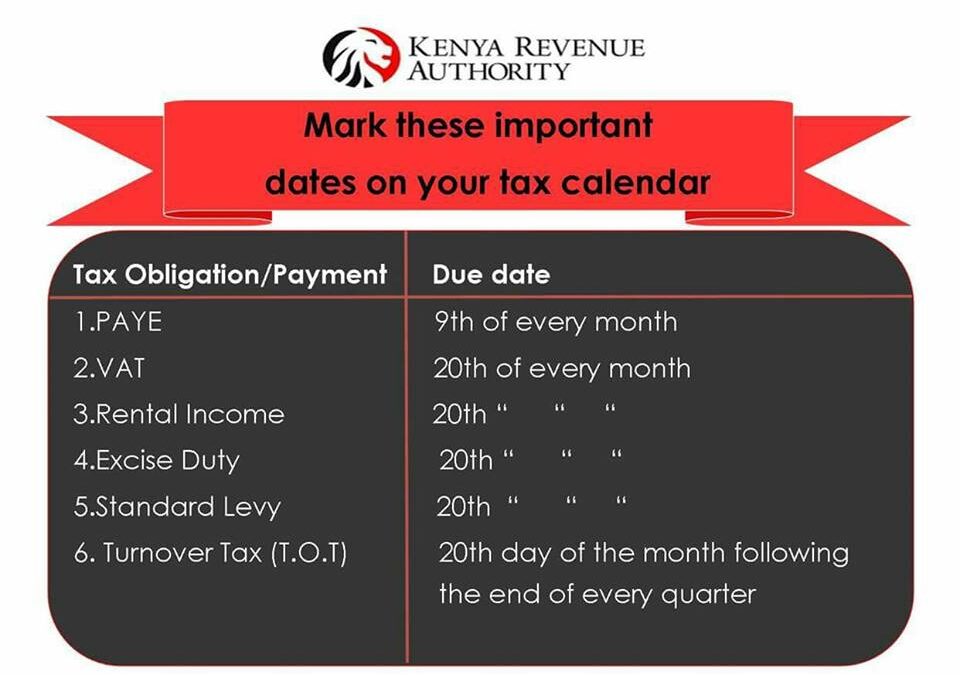
PAYE is generally due by the 9th of the following month, while VAT, turnover tax and monthly residential rental income returns are generally due by the 20th. The correct deadline depends on the tax obligation and whether you are filing a return or making a payment.
Use the calendar below alongside the obligations registered on your KRA PIN. Not every tax applies to every taxpayer.

The image is the original illustration. Use the updated table and notes below rather than relying on dates printed in a historical graphic.
Monthly tax deadlines
| Obligation | Return deadline | Payment deadline |
|---|---|---|
| PAYE | On or before the 9th of the following month | On or before the 9th of the following month |
| VAT | On or before the 20th of the following month | On or before the 20th of the following month |
| Turnover Tax, TOT | On or before the 20th of the following month | On or before the 20th of the following month |
| Monthly Residential Rental Income, MRI | On or before the 20th of the following month | On or before the 20th of the following month |
| Domestic excise duty | Monthly return by the 20th of the following month | Generally the 20th, but important exceptions apply below |
| Standards Levy, for liable manufacturers | Monthly return by the 20th of the following month | By the 20th of the following month under the 2025 Order |
For example, ordinary October PAYE is due by 9 November, while October VAT and TOT are due by 20 November. Turnover tax is monthly, not quarterly as the former table stated.
MRI is the monthly residential regime, not a deadline that applies to all rental income. A landlord outside that regime, or an appointed withholding agent, can have different obligations.
Standards Levy is a KEBS levy, collected through the prescribed payment process; it should not be confused with an ordinary income-tax charge.
Excise-duty payment exceptions
The monthly excise return deadline does not mean every excise payment can wait until the 20th:
- Licensed manufacturers of alcoholic beverages: section 36(1A) specifies payment by the fifth day of the following month.
- Betting and gaming: the special remittance rule requires payment within 24 hours of the closure of the day’s transactions.
- Excisable imports: payment is due at importation under the applicable customs process, not simply on the next monthly domestic deadline.
KRA’s 2025/26 service-charter table still shows older 24-hour wording for alcoholic beverages. The fifth-day rule above follows the amended Excise Duty Act and KRA’s specific notice on the 2024 amendment. Ask KRA to resolve any conflicting instructions for your particular account rather than treating the general 20th-day table as overriding the law.
Withholding tax
KRA’s withholding-tax guidance requires remittance within five working days after deduction. This is transaction-based, not a universal “pay on the 20th” obligation. Use the instructions for the specific deduction and generate the relevant payment documents.
Annual income-tax deadlines
| Obligation | General deadline |
|---|---|
| Individual annual income-tax return for a calendar year | By 30 June of the following year |
| Company income-tax return | Within six months after the accounting year ends |
| Balance of annual income tax | By the end of the fourth month after the year ends |
The annual return and balance-of-tax deadlines are different. For a December year-end, the usual balance-of-tax date is 30 April; the return is due by 30 June. Do not wait until the return deadline to pay a balance already due.
KRA’s guidance for the 2025 year of income states that the return filing window ended on 30 June 2026. If you missed it, check your account and address the outstanding obligation rather than waiting for the next year’s filing season.
Instalment tax
Where instalment tax applies, KRA lists payments by the 20th of the fourth, sixth, ninth and twelfth months of the year of income. For a calendar-year taxpayer these are 20 April, 20 June, 20 September and 20 December.
Agricultural-sector taxpayers have a different pattern: 75% in the ninth month and 25% in the twelfth month. TOT taxpayers do not pay instalment tax on their TOT-regime income.
Keep a practical tax calendar
- Check which obligations and accounting periods apply to you.
- Set separate reminders for preparing the return, submitting it and paying.
- File through the official service and retain the acknowledgement and payment receipt.
- Check that the payment is allocated to the correct tax and period.
- Obtain clarification on any special rule or official deadline notice before relying on it.
Tip: Submit and pay before the final day where possible. A filed return does not, by itself, prove that the payment has been made.
Related reading
How to file an employment income-tax return
Sources and useful links
- KRA: PAYE
- KRA: turnover tax
- KRA: monthly residential rental income
- KRA: withholding tax
- KRA: instalment tax
- KRA: annual income-tax filing guidance
- KRA: 2025/26 service charter and due-date table
- Kenya Law: Excise Duty Act, sections 35–36
- KRA: alcoholic-beverage and betting/gaming remittance notice
- KEBS: Standards Levy Order, 2025