A List of Kenyan Banks That Have Collapsed
Fact-checked on
In this article
Kenya’s banking sector has had its share of drama. From the finance houses of the 1980s to Chase Bank and Imperial Bank in the 2010s, dozens of banks have gone under and left depositors waiting years for their money.
When a bank fails, the Central Bank of Kenya (CBK) can place it under receivership and, if it cannot be saved, in liquidation. The Kenya Deposit Insurance Corporation (KDIC) then runs the receivership or liquidation and pays insured depositors.
Banks and Financial Institutions in Liquidation
KDIC lists 19 institutions that have been placed in liquidation:
| Institution | Date placed in liquidation |
|---|---|
| Postbank Credit Ltd | 20 May 1993 |
| Trade Bank Ltd | 18 August 1993 |
| Middle Africa Finance Ltd | 20 August 1993 |
| Pan-African Bank Ltd | 18 August 1994 |
| Pan-African Credit & Finance Ltd | 18 August 1994 |
| Thabiti Finance Co. Ltd | 19 December 1994 |
| Meridien BIAO Bank Ltd | 15 April 1996 |
| Kenya Finance Bank Ltd | 29 October 1996 |
| Ari Bank Corporation Ltd | 5 December 1997 |
| Prudential Bank Ltd | 5 May 2000 |
| Reliance Bank Ltd | 12 September 2000 |
| Fortune Finance Co. Ltd | 14 September 2000 |
| Trust Bank Ltd | 15 August 2001 |
| Euro Bank Ltd | 21 February 2003 |
| Prudential Building Society | 18 January 2005 |
| Daima Bank Ltd | 13 June 2005 |
| Dubai Bank Ltd | 24 August 2015 |
| Charterhouse Bank | 7 May 2021 |
| Imperial Bank Ltd | 8 December 2021 |
The Big Collapses of 2015–2016
Dubai Bank
The CBK placed Dubai Bank under receivership in August 2015, and KDIC was appointed liquidator on 24 August 2015.
Imperial Bank
Imperial Bank was placed under KDIC receivership in October 2015. It stayed in receivership for six years before being placed in liquidation on 8 December 2021.
Chase Bank
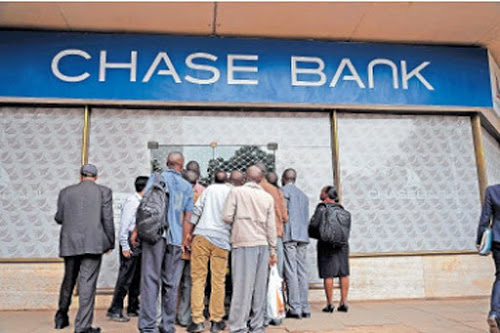
Chase Bank was placed under receivership on 7 April 2016. In August 2018, SBM Bank Kenya took over selected assets and 75% of the value of deposits under moratorium. In April 2021, the CBK cancelled Chase Bank’s licence and appointed KDIC to liquidate what remained.
Earlier Bank Failures
Kenya’s first big wave of failures came in the mid-1980s, when several mostly family- or community-owned banks and finance houses collapsed. These included Union Bank, Jimba Credit Corporation, Estate Finance, Estate Building Society, Business Finance, Nationwide Finance, Kenya Savings and Mortgages, Home Savings and Mortgages, and Citizen Building Society. The Banking Act of 1989 was passed soon after.
A second wave hit in 1993–1995, when many small banks failed, several of them linked to the Goldenberg scandal. A third wave followed in the late 1990s and early 2000s, including Trust Bank, Reliance Bank, Prudential Bank and Fortune Finance.
What Happens to Your Money if Your Bank Collapses?
- KDIC insures deposits up to KES 500,000 per depositor per bank. If you have several accounts in the same bank, they are added together for this limit.
- Money above the insured amount is paid back slowly, if at all, as the liquidator sells the bank’s assets and recovers loans.
- Spreading large savings across different banks keeps more of your money within the insured limit.
If you had money in a bank in liquidation, contact KDIC through its official website to find out how to claim.
Looking for a safe place for your savings? See our guides on licensed microfinance banks in Kenya and how to invest in unit trust funds.
Sources and useful links
- Kenya Deposit Insurance Corporation – Deposit insurance and list of institutions placed in liquidation
- Central Bank of Kenya – Press release: Chase Bank (In Receivership) and SBM Bank (Kenya)
- Business Daily – CBK revokes Chase Bank licence, kick-starts winding up
- Central Bank of Kenya – Dubai Bank liquidation notice (2015)
- Kenya National Assembly Official Record (Hansard), May 1999